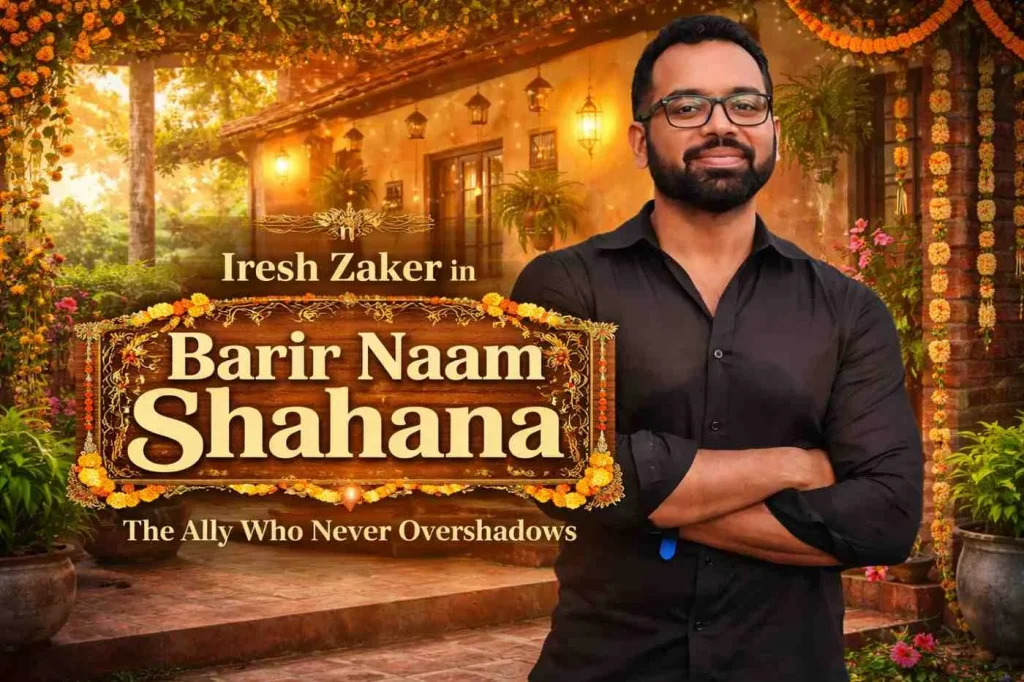
Iresh Zaker in Barir Naam Shahana: The Ally Who Never Overshadows
Not every powerful role announces itself loudly.
Some performances matter precisely because of what they choose not to do. They hold back so that someone else can step forward. They offer support without taking space. They make the story better by knowing their place within it.
That is exactly what Iresh Zaker brings to Barir Naam Shahana. And in a film built around one of the most compelling female-led stories in recent Bangladeshi cinema, that kind of discipline is its own form of craft.
At-a-Glance
- Title: Barir Naam Shahana (বাড়ির নাম শাহানা)
- Type: Feature Film
- Release Year: 2023
- Genre: Drama
- Director: Leesa Gazi
- Based On: Leesa Gazi’s 2011 novella, first published in Daily Prothom Alo
- Iresh Zaker’s Role: Shukhomoy Haldar, a sympathetic widower neighbour who stands as an ally to the protagonist
Plot Summary (Without Spoilers)
Imagine growing up in a small town in 1990s Bangladesh, where the rules about who you are allowed to become are written long before you are old enough to question them.
That is Dipa’s world.
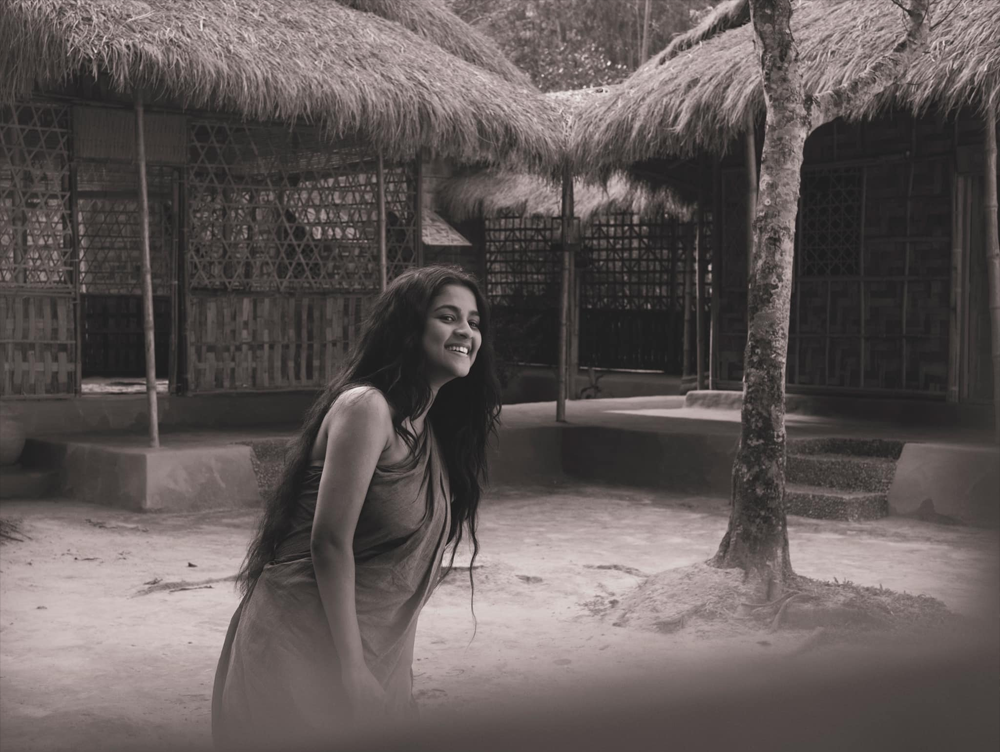
The central character of Barir Naam Shahana, Dipa is young, sharp, and unwilling to disappear quietly into the life others have planned for her. Raised in a household dominated by an uncle and aunt, she is married off to a widower in England through a trunk-call ceremony before she has had the chance to truly live. What follows is not a story of passive suffering. It is a story of escape, return, and the long, stubborn work of building a life on your own terms.
The film traces Dipa’s journey across seven years:
- From a forced marriage she never chose
- Through abuse she refuses to accept
- Back to Bangladesh as a divorcee carrying the full weight of social stigma
- And forward, steadily, toward becoming a qualified physician
Director Leesa Gazi, a Bangladeshi-born British filmmaker, spent over a decade bringing this story to screen. The script was written together with lead actress Aanon Siddiqua, who also plays Dipa, giving the film a rare quality of lived-in truth. The entire shoot took place over just nineteen days, in extreme heat and through storms, with a cast and crew that gave everything the material demanded.
The film premiered at the Jio MAMI Mumbai Film Festival in October 2023, where it won the Gender Sensitivity Award. It went on to screen at the BFI London Indian Film Festival, the Birmingham Indian Film Festival, the Dhaka International Film Festival, and multiple other international showcases. In 2025, it was selected as Bangladesh’s official submission for the Best International Feature Film category at the 98th Academy Awards, chosen from five competing films.
For a debut feature, that is a remarkable journey.
Iresh Zaker’s Role & Performance
The Character: Shukhomoy Haldar
Iresh Zaker plays Shukhomoy Haldar, a widower who lives near Dipa and occupies a quietly significant place in her story.
He is not a hero. He is not a saviour. That distinction matters enormously in a film as deliberately constructed as this one.
Director Leesa Gazi made a conscious creative choice: the men around Dipa would not rescue her. They would not swoop in with answers or solutions. Shukhomoy is written as a figure of genuine warmth and sympathy, someone who sees Dipa clearly and responds to her with decency. But the full arc of the story, every hard-won step of Dipa’s transformation, remains entirely in her own hands.
In a lesser film, a sympathetic male neighbour becomes a crutch the story leans on. Here, he is simply a human being in Dipa’s orbit. Present. Supportive. And wise enough to know the limits of his role.
The Performance
What Iresh Zaker does with Shukhomoy is a study in restraint and intention.
He plays a man who is warm without being intrusive, present without being dominant. In a cast anchored by Aanon Siddiqua’s extraordinary central performance, Iresh finds his register quickly and holds it consistently throughout. There is no moment where his character reaches for attention the story has not offered him.
That is harder to do than it sounds.
Iresh himself has spoken openly about the experience of working on this film. He described the production process as a beautiful exception to the usual chaos of feature film shoots, noting that the pre-production and production were unusually organised and that every cast and crew member brought a rare level of dedication and discipline. He said that the environment made it easy, as an artist, to concentrate on performance.
That concentration shows on screen. Shukhomoy Haldar is not a large role, but it is a precise one. And Iresh delivers it with the quiet confidence of someone who understands that serving the story is always the point.
Overall Review & Themes
Barir Naam Shahana is a film of striking moral clarity.
It does not trade in easy villains or uncomplicated heroism. It places one woman at its centre and builds an entire world around the question of what it costs to live honestly within a society that would prefer you did not.
The themes it carries are both deeply rooted in Bangladeshi reality and universally legible:
- The machinery of patriarchy operating through family rather than strangers
- The social weight placed on women who refuse to stay quietly in suffering
- The long, unglamorous work of self-determination across years rather than moments
- And the possibility, even in the most constrained circumstances, of choosing who you become
The film is not without its limitations. Some critics noted that certain subplots remain underdeveloped, and that the narrative occasionally touches on issues without fully excavating their complexity. But these are the minor shortcomings of an ambitious debut, not fatal weaknesses.
What Leesa Gazi achieves is a film that opens on liberation rather than trauma, and closes on hope rather than despair. That is a deliberate and courageous choice. The cinematography, anchored by a recurring motif of mirrors, gives the film a visual language that matches its emotional intelligence. The score by Sohini Alam and Oliver Weeks weaves folk and contemporary textures together in a way that mirrors Dipa’s own negotiation between tradition and selfhood.
And at the centre of everything, Aanon Siddiqua delivers one of the most fully realised performances in recent South Asian cinema.
The Verdict
Barir Naam Shahana is the kind of film that makes you feel the weight of ordinary courage.
Not the dramatic, visible kind. The quiet kind. The kind that shows up every day, in small towns, in unremarkable homes, in women who simply refuse to stop.
For Iresh Zaker, this film represents something worth paying attention to. He was drawn to the script because of how it approached feminism, not as a slogan but as a lived reality told with sophistication and restraint. He showed up for nineteen days of difficult shooting and gave the film exactly what it needed from him.
No more. No less.
In a career built on careful choices and consistent craft, Barir Naam Shahana is another marker of an actor who understands that the best thing you can do for a great story is trust it.