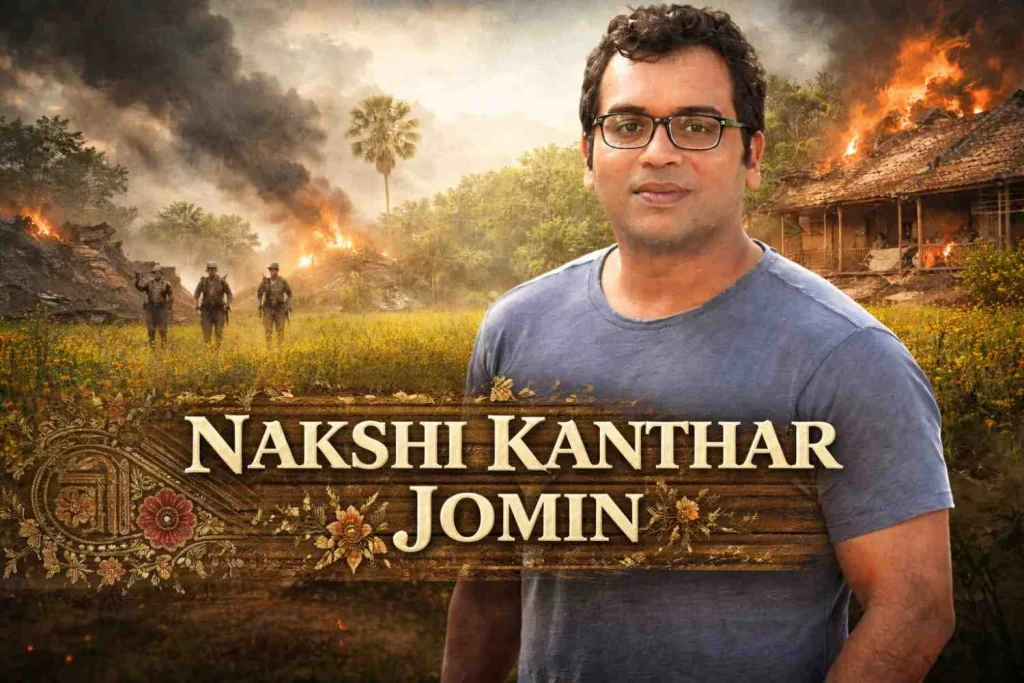
Nakshi Kanthar Jomin: Iresh Zaker in a War Story That Lasts
War films carry a particular burden. They are not just stories. They are responsibilities.
To tell a story set against the 1971 Liberation War of Bangladesh is to handle something that still lives in the memory of a people. It is to walk into grief that has not fully healed and ask an audience to go there with you. That takes courage from a director. And it takes honesty from every actor who steps in front of the camera.
Iresh Zaker brought that honesty to Nakshi Kanthar Jomin. In a film built around extraordinary performances and a deeply human story, his presence holds quiet weight.
At-a-Glance
- Title: Nakshi Kanthar Jomin
- Type: Feature Film
- Release Year: 2023
- Genre: Drama, War, Historical
- Director: Akram Khan
- Based On: “Bidhobader Kotha,” a novel by Hasan Azizul Haq
- Iresh Zaker’s Role: One of two brothers whose conflict shapes the fate of the sisters at the centre of the story
Plot Summary (Without Spoilers)
There is a particular kind of loss that war produces. Not the kind that happens on battlefields, but the kind that happens inside homes. Between people who once shared everything.
That is the territory Nakshi Kanthar Jomin occupies.
Based on the celebrated novel “Bidhobader Kotha” by Hasan Azizul Haq, the film follows two sisters, Rahela and Saleha, as they try to hold their lives together against the chaos of 1971. But this is not a conventional war story. The violence here is not only external. It is domestic. Intimate. The kind that cuts deeper because it comes from people you know.
The film depicts:
- The everyday brutality of a country at war
- Hatred and enmity rising even within families
- A conflict between two brothers that tears at everything around them
- And through it all, the bond between two sisters who refuse to break
Against that violent backdrop, Rahela and Saleha become the emotional anchor of the entire film. Their resilience is not loud or heroic. It is quiet, enduring, and deeply real.
Director Akram Khan does not sensationalise any of it. He lets the story breathe. He trusts his cast. And the result is a film that has travelled far beyond the borders of Bangladesh, winning recognition on international stages that rarely pay attention to South Asian cinema of this kind.
Iresh Zaker’s Role & Performance
The Character
Iresh Zaker plays one of two brothers whose opposing positions during the war create a fracture that runs through the entire story.
The brothers are not background figures. They are catalysts. Their conflict, rooted in ideology and personal history, is what drives the domestic tension the film is built on. It is through them that the audience witnesses how war does not just divide nations. It divides families. Turns people who grew up under the same roof into strangers, and sometimes into enemies.
It is a role that requires an actor to carry ideology without losing humanity. To be on one side of a conflict without becoming a caricature of it.
The Performance
What makes Iresh Zaker’s performance in Nakshi Kanthar Jomin worth noting is his commitment to the emotional truth of his character.
Period films set during the Liberation War risk a certain predictability. Characters can easily slide into symbols rather than people. Iresh resists that. He plays a man shaped by his moment in history, but he plays him as a man first.
His scenes alongside Rawnak Hasan, who plays the other brother, carry a tension that feels lived-in rather than performed. There is a history between these two characters that you sense before it is ever explained. That kind of work does not happen by accident. It comes from an actor who has done the internal preparation.
Within an ensemble anchored by Jaya Ahsan and Fariha Shams Sheuti’s powerful central performances, Iresh holds his place without overreaching. He understands his function in the story and serves it completely.
Overall Review & Themes
Nakshi Kanthar Jomin is a film that earns every award it has received.
It won the Third Best Film in the Asian Competition category at the 14th Bengaluru International Film Festival. It triumphed at the Busan Peace Film Festival. It received a nomination for the ICFT-UNESCO Gandhi Medal at the International Film Festival of India, making it the first Bangladeshi film to reach that distinction.
The themes it carries are ones that Bangladeshi audiences feel personally, and that international audiences recognise universally:
- The cost of war on ordinary people who never chose to be part of it
- The strength of women who survive where systems fail them
- The way ideology can poison the closest relationships
- And the question of what remains when everything else is taken away
The film does not offer easy answers. It does not wrap its grief in resolution. It sits with the weight of what happened and asks the audience to do the same. That is a brave creative choice, and it is one that pays off.
The Verdict
Nakshi Kanthar Jomin is not a comfortable film. It is not meant to be.
It is the kind of work that stays with you because it refuses to let history remain abstract. It puts faces and voices and domestic spaces to a chapter of Bangladesh’s story that deserves to be remembered with full human detail.
For Iresh Zaker, this film is another marker of a career defined by careful choices. He does not chase visibility. He chooses material that matters, brings genuine craft to it, and steps back to let the work speak.
In Nakshi Kanthar Jomin, the work speaks clearly.